Skin, explained
Your Most-Asked Sunscreen Questions: Answered
It’s finally safe to say: we can all agree sunscreen is a non-negotiable in every daily skincare routine to protect against both premature ageing and skin cancer. Yet, for many, choosing a sunscreen remains anything but straightforward.…

It’s finally safe to say: we can all agree sunscreen is a non-negotiable in every daily skincare routine to protect against both premature ageing and skin cancer. Yet, for many, choosing a sunscreen remains anything but straightforward. Enter endless information (and misinformation) coupled with ratings and vs. UVB, it’s no wonder we’re seeing brains as frazzled as unprotected skin.
The good news? I’m here to answer the most common sunscreen questions that have many of you stumped and also share my top-rated products for different skin types and preferences. So, let’s get to it!
What’s the difference between UVA rays and UVB rays?
UVA rays are long-wavelength ultraviolet rays that penetrate deep into the skin, reaching the dermis (the middle layer of the skin). They cause long-term harm such as premature ageing, breakdown and cellular damage. As a result, frequent unprotected exposure can lead to wrinkles, hyperpigmentation, sagging and an increased risk of skin cancer.
UVB rays are shorter-wavelength ultraviolet rays that primarily affect the outer layer of the skin (the epidermis) and cause direct DNA damage. Prolonged unprotected exposure can result in sunburn, blistering and an increased risk of skin cancer.
An easy way to remember the above is: UVAgeing vs. UVBurning.
What does an SPF rating actually mean?
SPF stands for ‘Sun Protection Factor’ and measures how well a sunscreen protects the skin against UVB rays. The number that follows ‘SPF’ (e.g. 30) indicates how much longer your skin is protected against burning compared to if you weren’t wearing the sunscreen. For example, SPF 30 means your skin can tolerate approximately 30 times more UVB exposure before burning than it could without the sunscreen being applied. So, if your skin would normally start to burn after 10 minutes in the sun, applying SPF 30 could extend that protection to roughly 300 minutes. It’s therefore vital to know and be attentive to your own skin.
If you prefer to think about SPF rating more directly in terms of its UVB-blocking capacity, then as long as the sunscreen is applied evenly and frequently, SPF 30 will allow about 1 in 30 UVB rays to reach the skin - meaning it blocks around 97% of UVB radiation. By comparison, SPF 50 only allows 1 in 50 to reach the skin - blocking about 98%.
It’s also very important to note that the SPF rating reflects protection against UVB rays, so it’s imperative to choose a sunscreen that shields your skin against both UVA (ageing) and UVB (burning) rays. Which brings us to our next question…
What is a ‘broad-spectrum’ sunscreen?
A broad-spectrum sunscreen is a sunscreen which protects your skin against both UVA and UVB rays – an imperative choice to shield against premature ageing, sunburn and skin cancer. For the highest possible protection, look for a broad-spectrum sunscreen with an SPF of 50+, coupled with a 5* or PA++++ UVA rating.
It’s also worth noting that, in Europe, UVA protection must be at least ⅓ of the declared SPF rating to be able to be sold as a sunscreen product. So, all sunscreens sold in Europe will contain some level of UVA protection.
How much sunscreen do I need to apply for optimal protection?
For your face, neck and décolletage you should apply approximately ¼ of a teaspoon of sunscreen. Alternatively, you can use the ‘3 finger rule’. Apply a generous squeeze of sunscreen along your index, middle, and ring fingers then apply evenly.
For your body, you should use roughly 1 teaspoon for each arm, leg, back and chest. Or, per body part, measure by applying a generous squeeze from the tip of your middle finger to your wrist.
Do I need to reapply throughout the day?
You should reapply your sunscreen every 2 hours if you’re in prolonged and/or direct sunlight and always reapply after sweating, swimming or drying yourself with a towel.
You should also reapply sunscreen right away if you notice redness in your skin, however slight. If you’re indoors and not in direct sunlight or near windows, a single morning application generally provides sufficient protection for that day.
Do I need to apply sunscreen all year round?
Yes, absolutely! You should apply sunscreen every single day – even on cloudy days because UV rays can still penetrate clouds. UVA is actually present all year round and can largely penetrate glass as well as clouds, whereas UVB intensity varies depending on the season and time of day and is mostly absorbed by ordinary glass.
What’s the difference between mineral (aka ‘physical’) and chemical sunscreens?
In a nutshell, mineral sunscreens (zinc oxide and titanium dioxide) sit on the skin surface and protect by reflecting UV rays. They work instantly and are generally less likely to cause irritation, so are a great choice for sensitive or blemish-prone skin.
Meanwhile chemical sunscreens (most commonly avobenzone or oxybenzone) absorb into the skin and work by converting UV rays into heat before releasing them. They take 15-30 minutes to take effect but are usually lightweight and invisible on the skin, which many prefer to the chalky residue that some mineral sunscreens can cause.
Both are highly effective, so it ultimately comes down to skin type and preference.
Can I still tan while wearing sunscreen?
Technically, you can. However, if you’re successfully applying and reapplying the correct amount of sunscreen needed for full UVA and UVB protection, then you shouldn’t be tanning – and that’s because tanning is a direct sign of sun damage! Of course, even perfectly-applied sunscreen won’t be able to completely protect the skin from UV damage 100% of the time, but try your very best as tanning not only indicates damage to the DNA in our skin cells but it also accelerates premature ageing. My advice? Embrace your pale complexion, or borrow that tan from a bottle.
Does a moisturiser or a foundation containing SPF work in the same way as a sunscreen?
Again, in theory this is a ‘yes’. However, it’s important to be aware that many non-sunscreen formulas containing SPF generally only offer UVB protection. You would also need to ensure that you’re applying an ample amount of the formula to sufficiently protect your skin, and also reapplying it which is not really doable when it comes to foundations in particular.
My Top Tips
1. If applying a chemical sunscreen, wait 15-30 minutes for it to fully absorb before going out in direct sunlight.
2. Check your sunscreen’s expiry date! A sunscreen typically lasts 12-18 months after opening, so ensure you check the PAO symbol. Read more on this here.
3. When applying sunscreen to your face, don’t forget your ears!
My Top Recommendations [for face]
For sensitive skin: La Roche-Posay Anthelios UVMune 400 Invisible Fluid Non-Perfumed Suncream SPF50+ 50ml
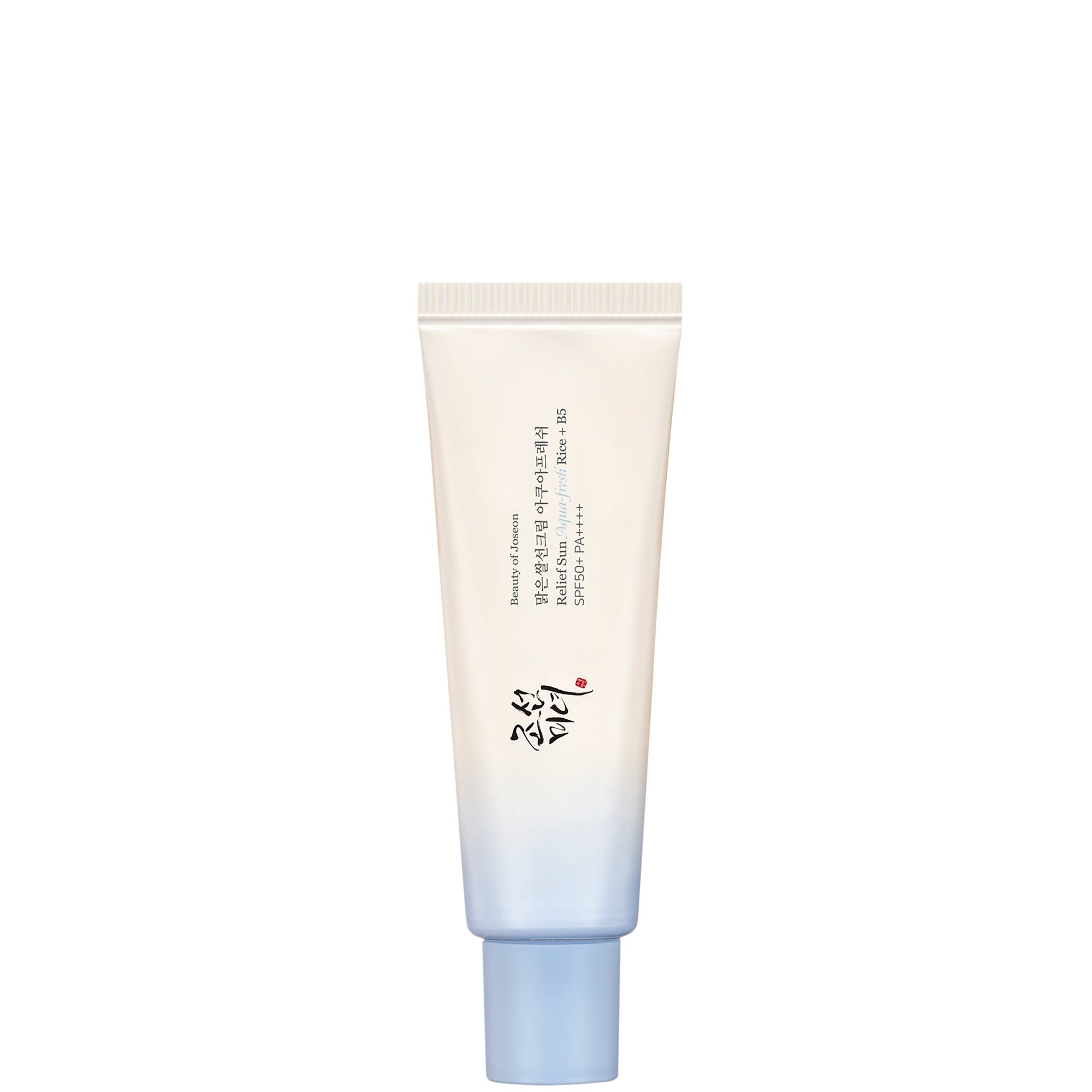
For dry skin: Beauty of Joseon Relief Sun Aqua-Fresh Rice + B5 SPF50+ 50ml
For oily / blemish-prone skin: Kiehl’s Ultra Light Daily UV Defense Aqua Gel SPF50
For easy application under makeup (and my current personal favourite): Queen Screen™ SPF 50+ Luminising SKINSCREEN™ 50ml
[All of the above should be applied as the last step of your skincare routine, and before your makeup.]
If you’re a ‘full face of makeup even in the sun’ kinda person but need to reapply, try: Naked Sundays SPF50+ Hydrating Glow Mist Setting Spray Sunscreen 50ml
Or if you like some light coverage mixed in with your sunscreen (perfect for holiday), then try: Merit The Uniform Tinted Mineral Sunscreen SPF 50

DISCLAIMER: While I’m not a doctor or dermatologist, I’ve spent much of my career immersed in the beauty industry, particularly skincare. As a former beauty trends editor, I scoured the global market to identify and test some of the most innovative sunscreen formulas out there. I later worked on the brand team at one of the UK’s fastest-growing skincare companies, helping bring to market some of today’s most advanced sunscreen technologies.
This post is not sponsored, and none of the links are affiliate links. All product recommendations and opinions are entirely my own.