Ingredient deep dive
Exfoliants: Explained
Exfoliation is, without a doubt, one of skincare’s most powerful tools. Although often misunderstood and sometimes overused, it’s undeniably transformative when done correctly. Today’s formulas span a sophisticated spectrum of chemical a…

is, without a doubt, one of skincare’s most powerful tools. Although often misunderstood and sometimes overused, it’s undeniably transformative when done correctly. Today’s formulas span a sophisticated spectrum of chemical and physical exfoliants, with each offering specific benefits to serve an array of skin types and concerns. From glow-boosting and pore-clearing to next-gen PHAs and reinvented physical exfoliants, this guide will break down what sets exfoliants apart and how to use them correctly, plus the formulas I rate the most following my years of experience within the depths of the industry.
CHEMICAL EXFOLIANTS
Chemical exfoliants (aka exfoliating acids) primarily refer to 3 categories of ingredients: AHAs, BHAs and PHAs.
AHAs (Alpha Hydroxy Acids)
What are they?
Water-soluble acids which are used to exfoliate the surface of the skin. They work by loosening the ‘glue’ that holds dead skin cells to the skin. They also stimulate skin cell renewal. Key examples are , , and mandelic acid.
How do they benefit the skin?
By exfoliating the surface of the skin, AHAs work to smooth and brighten the complexion while delivering visible radiance and glow.
Ideal for: Those with uneven skin texture, discolouration, dullness and/or fine lines.
Suitable for: Normal, combination and mature skin types.
When to apply: Can be applied AM or PM, but PM is recommended to allow the ingredient to work effectively alongside your skin’s natural overnight regeneration process. Apply after cleansing and before the rest of your routine (including a moisturiser).
Be cautious: Whether using AM or PM, always apply sunscreen daily when using AHAs as the surface exfoliation process makes your skin more vulnerable and sensitive to the sun (photosensitive).
If you’re new to AHAs, it’s recommended that you start using a new product once or twice a week, gradually increasing the frequency to build up your skin’s tolerance. Stop usage if your skin shows any signs of irritation such as redness or flaking.
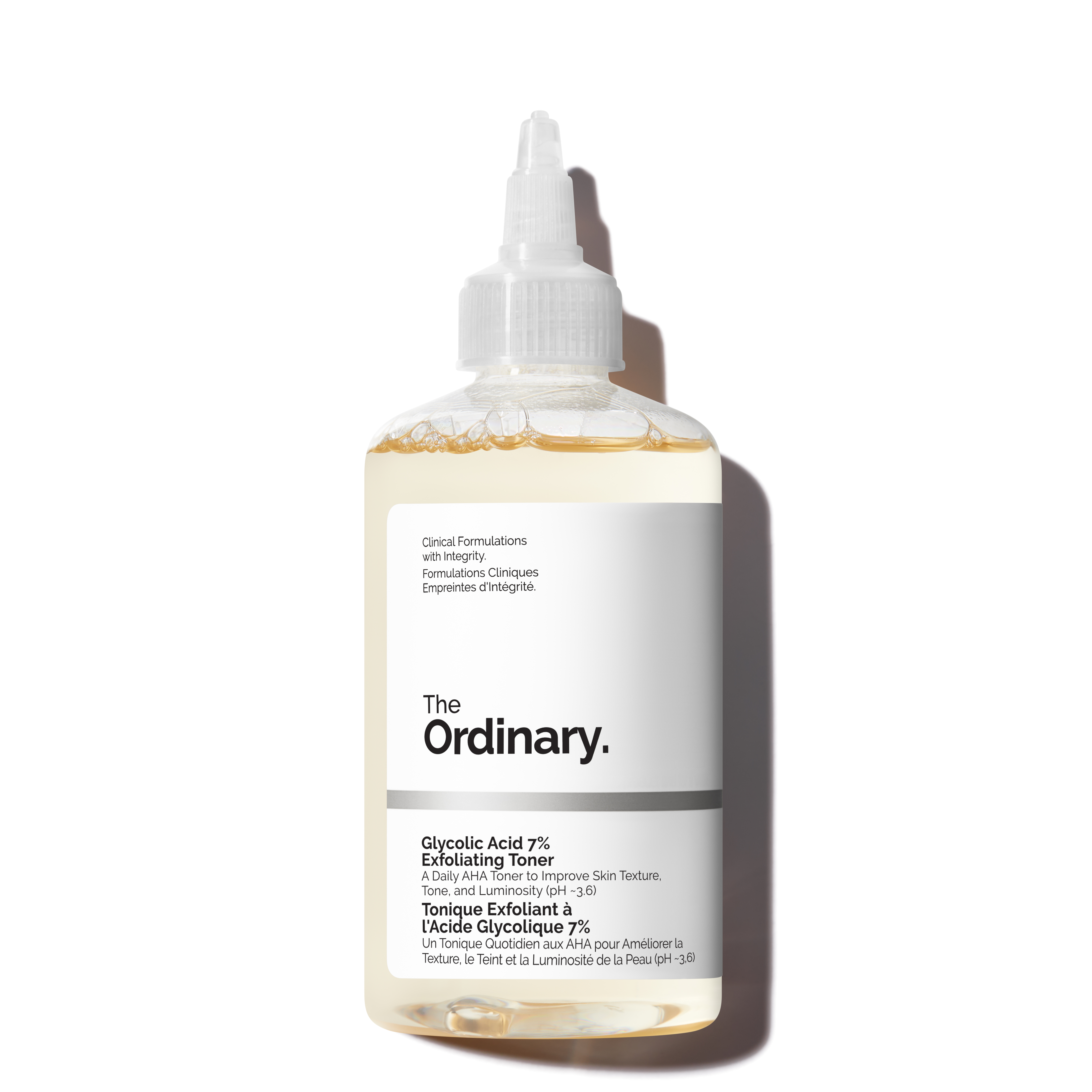
I recommend: The Ordinary Glycolic Acid 7% Exfoliating Toner, Pixi Glow Tonic, Byoma Brightening Toner
BHAs (Beta Hydroxy Acids)
What are they?
Oil-soluble acids which penetrate deep into the pores to dissolve excess sebum and dead skin cells. The most common and widely-used example is .
How do they benefit the skin?
By exfoliating within the pores, BHAs work to reduce the look of blemishes, blackheads, whiteheads and enlarged pores. They also help to combat breakout-causing bacteria while reducing inflammation and balancing excess oil production.
Ideal for: Those who suffer with acne, blemishes, blackheads, enlarged pores, and/or excess oil on the skin surface.
Suitable for: Oily, combination and blemish-prone skin types.
When to apply: Can be applied AM or PM, but PM is recommended to allow the ingredient to work effectively alongside your skin’s natural overnight regeneration process. Apply after cleansing and before the rest of your routine (including a moisturiser).
Be cautious: BHAs can be drying on the skin, particularly if your skin isn’t used to them. If you’re new to BHAs, start with a lower concentration formula (0.5% - 1%) and only use 1-2 times per week for the first couple of weeks to build up your skin’s tolerance. If your skin shows no signs of irritation, you can gradually increase your usage. Stop usage if your skin shows any signs of irritation such as redness or flaking.
Even if you’ve used BHAs before, always follow product instructions, don’t overuse, and always follow use with a moisturiser to support your . Again, always apply sunscreen daily when using BHAs as the exfoliation process makes your skin more vulnerable and sensitive to the sun (photosensitive).
I recommend: Paula’s Choice 2% BHA Exfoliating Toner, La Roche-Posay Effaclar Clarifying Toner, Medicube Zero Pore Pads
PHAs (Polyhydroxy Acids)
What are they?
PHAs are gentle exfoliating acids which, like AHAs, work on the surface of the skin. However, because of their large molecular size, they penetrate the skin at a slower rate without causing irritation.
How do they benefit the skin?
PHAs work to smooth uneven skin texture while brightening the skin tone and boosting radiance. They also act as (binding moisture to the skin) and (protecting the skin against external stressors).
Ideal for: Those who need a gentle formula but want to improve the look of uneven skin texture, discolouration and dullness.
Suitable for: Sensitive, dry, reactive and/or eczema-prone skin types.
When to apply: Apply AM or PM, after cleansing but before the rest of your skincare routine (including a moisturiser).
Be cautious: If you opt for a PHA because you have particularly sensitive skin, I would recommend doing a patch test before the first use, as well as gradually building up your usage over time. And, although correct use of PHAs should not cause photosensitivity, applying a sunscreen daily is always a good idea.
I recommend: The Inkey List PHA Toner, Biodance Skin Refining Mild PHA Toner, Minimalist Polyhydroxy Acid (PHA) 03% Toner
PHYSICAL EXFOLIANTS
What are they?
Also known as ‘mechanical’ or ‘granular’ exfoliants, physical exfoliants use friction to manually remove dead skin cells from the surface layer of your skin. It’s worth noting that, in most cases, today’s physical exfoliants have undergone a renaissance and shed their harsh reputation in favour of finely-milled, skin-respecting ingredients. The most common examples of physical exfoliants are natural ingredients such as jojoba beads, rice granules, sugar, or finely-milled seed powders.
*Microbeads are banned in skincare formulations in most countries as they are non-biodegradable plastics – harmful to both the skin and the environment. You shouldn’t come across them, but avoid if you do!
How do they benefit the skin?
They work by buffing away dead, dull skin cells to reveal the smoother, brighter skin underneath. In doing so, they also help to prevent blemish-causing build-up.
Ideal for: Those with significantly uneven skin tone and texture looking for immediate, surface-level results.
Suitable for: Normal and oily skin types.
*Avoid if you have sensitive or acne-prone skin.
When to apply: Apply AM or PM after cleansing and before the rest of your routine (including a moisturiser). Apply to damp skin using gentle circular motions.
Be cautious: If products contain abrasive materials (such as crushed nut shells) or are used too vigorously, they can cause micro-tears in the skin. These tears can cause significant irritation, damage the skin barrier, and serve as an entry point for bacteria.
I would suggest using physical exfoliants sparingly; typically 1-2 times per week to prevent over-exfoliation. Always apply sunscreen daily as the exfoliation process makes your skin more vulnerable and sensitive to the sun (photosensitive).
I recommend: Neal’s Yard Damask Rose Facial Polish, Liz Earle Gentle Face Exfoliator, Dermalogica Daily Microfoliant (hybrid physical & chemical exfoliator)
SUMMARY
AHAs – work on the skin surface
BHAs – work within the pores
PHAs – work like AHAs but are gentler
Physical exfoliants - work on the skin surface using friction
MY TOP TIPS WHEN USING EXFOLIANTS
1. If you’re using a new product for the first time, gradually increase your usage over a couple of weeks to allow your skin time to build up tolerance. If you have particularly sensitive or reactive skin, conduct a patch test before your first use.
2. Whether you’re applying an exfoliant AM or PM, always apply a sunscreen daily to protect new skin cells.
3. Never layer exfoliants on top of one another - e.g., do not apply a BHA on top of an AHA.
*Some products do use a combination of exfoliants for a dual-action effect but these will be an expertly-formulated balance that’s been tested for safe use.
4. Always follow a product’s instructions carefully. Some chemical exfoliants can be used up to twice daily, but only do so if this is specified on the packaging and always note your skin’s response before continuing.
5. Always moisturise after any and every form of exfoliation to protect your skin barrier and prevent irritation / dryness.
6. You can apply exfoliants either directly to the skin using clean fingers or by using a clean cotton pad. Most formulas will specify which is recommended for that product on the packaging.
7. Remember that the vast majority of chemical exfoliants are leave-on products, while most physical exfoliants are a rinse-off format. Again, always check product instructions.

DISCLAIMERS:
While I’m not a doctor or dermatologist, I’ve spent much of my career immersed in the beauty industry, particularly skincare. As a former beauty trends editor, I scoured the global market to identify and test some of the most innovative exfoliant formulas out there. I later worked on the brand team at one of the UK’s fastest-growing skincare companies, helping bring to market some of today’s most advanced exfoliant technologies.
This post is not sponsored, and none of the links are affiliate links. All product recommendations and opinions are entirely my own.